
3File Maintenance
Option 7Dunning Codes
Use this function to enter and edit dunning letter text. You may enter any number of letters for each dunning code. Each letter has a different number of days to age and different text for the body of the letter. This would allow you, for example, to have different letters for 30, 60, 90, and 120 day-overdue invoices.
When you use this function, a record of all entries will be printed. For additions, all new field contents are printed; for deletions, the deleted record’s contents are shown; for changes, both old field contents and new field contents are shown; and in all cases, the User ID, date, and time are printed.
On the following pages, the two screens displayed by this function are shown.
The screen shown below presents information about Dunning Codes.
This file identifies and describes each set of dunning letters.
Dunning Codes screen

When the key value for a particular record is requested, you can review all the records in the file by selecting the Scan option. The records will be presented on an “Access” screen, and you will be allowed to scan the available data until you find the record you want. Then, position the cursor by that record and press ENTER’ the record will be displayed for editing.
Note that the Audit Info option is available at the bottom of this screen. When this option is invoked, the Audit Information overlay appears and displays the date the record was created and who created it, as well as the date the record was last modified and who modified it. Press the END key or the RETURN key to clear the overlay from your screen. The information displayed in the Audit Information overlay is system-supplied and non-modifiable.
Data items for the preceding screen are described below:
- Code
Positive number, up to 3 digits
By using Scan you may use this as NA ‘access key’ for selecting records.
Provide a unique code to identify each set of dunning letters.
- Description
Alphanumeric, up to 30 characters Required
Describe this set of dunning letters.
Press ENTER to continue to the next screen.
Select the Next Record option to go to the next Dunning Codes record.
At this screen, the use of the MODE keys - ADD, DEL, CHG, or INQ - pertain to those records in the Dunning Codes file.
The screen shown below presents information about Dunning Letters by Age.
This file contains the text used when printing dunning letters for each ageing category.
Dunning Letters by Age screen
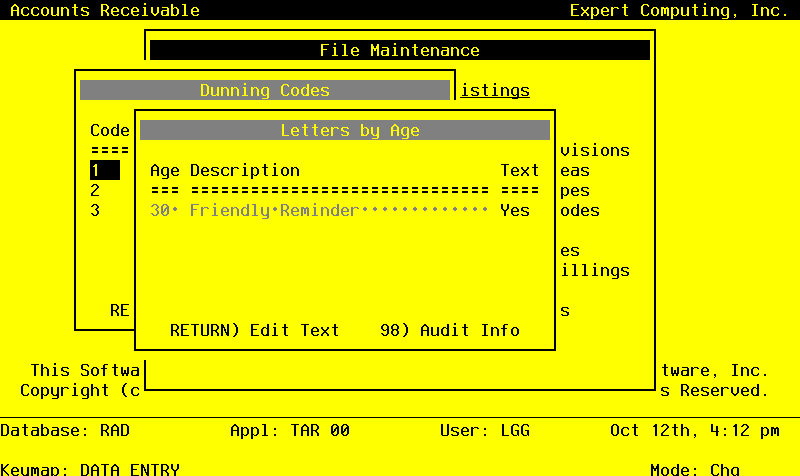
When the key value for a particular record is requested, you can review all the records in the file by selecting the Scan option. The records will be presented on an “Access” screen, and you will be allowed to scan the available data until you find the record you want. Then, position the cursor by that record and press ENTER; the record will be displayed for editing.
Note that the Audit Info option is available at the bottom of this screen. When this option is invoked, the Audit Information overlay appears and displays the date the record was created and who created it, as well as the date the record was last modified and who modified it. Press the END key or the RETURN key to clear the overlay from your screen. The information displayed in the Audit Information overlay is system-supplied and non-modifiable.
Data items for the preceding screen are described below:
- Age
Positive number, up to 3 digits
Identify the number of days past due an invoice must be, in order to generate this dunning text.
- Description
Alphanumeric, up to 30 characters Required
Describe this dunning code and age combination.
- Text
Enter a text field, up to 600 characters in length. You can use the options to split, join, or redisplay text, the End Paragraph option, and the fixed space character to “hold” spaces in this field.
Supply the body of the dunning letter for this age. This is the text that will appear above the statement information when the dunning letter is printed.
Press ENTER to save the information on this screen.
Select the Previous Window option to go back to the Dunning Codes screen. Select the Next Record option to go to the next Dunning Letters by Age record. Select the End option to go to the next Dunning Codes record.
At this screen, the use of the MODE keys - ADD, DEL, CHG, or INQ - pertain to those records in the Dunning Letters by Age file.