
3File Maintenance
Option 5Sales Tax Codes
Use this function to enter and edit Sales Tax Codes records. For each tax code, you should enter and describe the tax districts within that tax code, and supply each tax percentage.
Sales Tax Codes are used during invoice entry in Accounts Receivable and Order Entry to calculate the sales tax due. For each customer, you supply a default Sales Tax Code and District, which is transferred to each new invoice that is entered. These default values can be changed.
When you use this function, a record of all entries will be printed. For additions, all new field contents are printed; for deletions, the deleted record’s contents are shown; for changes, both old field contents and new field contents are shown; and in all cases, the User ID, date, and time are printed.
On the following pages, the two screens displayed by this function are shown.
The screen shown below presents information about Sales Tax Codes.
This file contains records identifying the tax codes which apply to customers in Account Receivable.
Sales Tax Codes screen
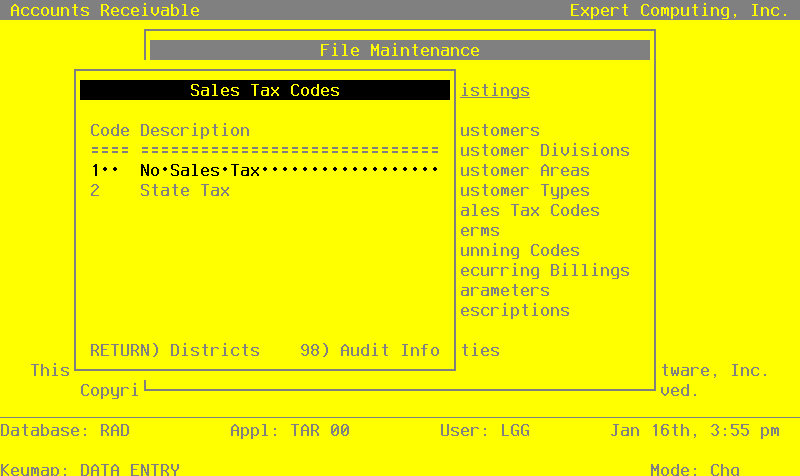
When the key value for a particular record is requested, you can review all the records in the file by selecting the Scan option. The records will be presented on an “Access” screen, and you will be allowed to scan the available data until you find the record you want. Then, position the cursor by that record and press ENTER; the record will be displayed for editing.
Note that the Audit Info option is available at the bottom of this screen. When this option is invoked, the Audit Information overlay appears and displays the date the record was created and who created it, as well as the date the record was last modified and who modified it. Press the END key or the RETURN key to clear the overlay from your screen. The information displayed in the Audit Information overlay is system-supplied and non-modifiable.
Data items for the preceding screen are described below:
- Tax Code
Positive number, up to 3 digits Scan by this field (access key)
Supply a unique number to identify this sales tax code.
- Description
Alphanumeric, up to 30 characters Required
Describe this sales tax code.
The entered data is validated. During validation, including access to other files, conditions may be found which cause messages to be displayed. Errors (E), Warnings (W), and Messages (M) that may result are shown below:
Press ENTER to continue to the next screen.
Select the Next Record option to go to the next Sales Tax Codes record.
At this screen, the use of the MODE keys - ADD, DEL, CHG, or INQ - pertain to those records in the Sales Tax Codes file.
The screen show below presents information about Sales Tax Districts.
Each tax code may have any number of jurisdictions to which it refers; each jurisdiction may have its own tax percentage. In the case of overlapping jurisdictions and/or compound sales tax, a separate “tax district” should be created for each combination or separate jurisdiction.
This file contains one record for each tax district within a specified tax code.
Sales Tax Districts screen
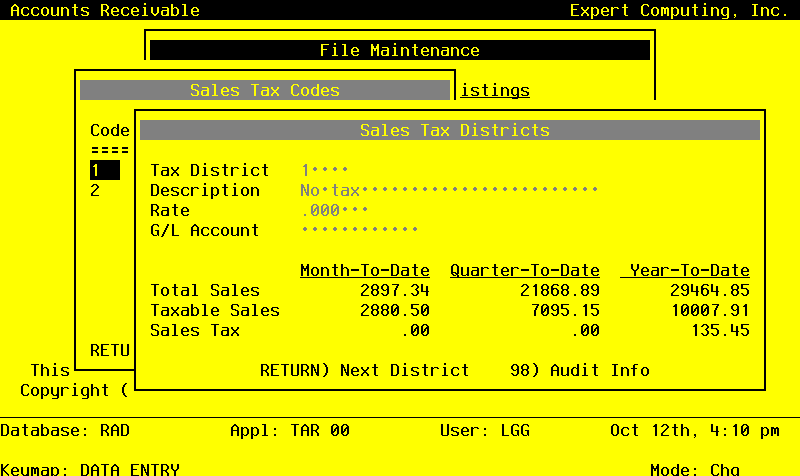
When the key value for a particular record is requested, you can review all the records in the file by selecting the Scan option. The records will be presented on an “Access” screen, and you will be allowed to scan the available data until you find the record you want. Then, position the cursor by that record and press ENTER; the record will be displayed for editing.
Note that the Audit Info option is available at the bottom of this screen. When this option is invoked, the Audit Information overlay appears and displays the date the record was created and who created it, as well as the date the record was last modified and who modified it. Press the END key or the RETURN key to clear the overlay from your screen. The information displayed in the Audit Information overlay is system-supplied and non-modifiable.
Data items for the preceding screen are described below:
- Tax District
Alphanumeric, up to 5 characters Required
Supply a unique code to identify this taxing district.
- Description
Alphanumeric, up to 30 characters Required
Describe this taxing district.
- Rate
Number, up to 2 digits and 3 decimals
Provide the percentage to be used as the tax rate.
If your system includes Order Entry, this tax rate is applied to sales in this taxing district. If Order Entry is not part of your system, this field is used for information only.
NOTE: Because only one district is entered on an invoice, the tax rate must be the sum of all jurisdictions’ taxes that apply to a customer located in that district. Fro example if state tax is 6 percent and local tax is 2 percent enter 8 percent in this field.
- G/L Account
Upper case, up to 12 characters Scan available
Define the General Ledger account to which this district’s sales taxes will be credited. During invoice posting, this account will be credited for taxes billed to the customer.
If your system includes General Ledger, this number must be on file in the Chart of Account file, and the system displays the corresponding description so that you can verify your entry.
If the Rate is zero, you can leave this field blank.
- Total Sales
Number, up to 9 digits and 2 decimals Display only
During Initial Setup, you can enter the total amounts of the month-to-date, quarter-to-date, and year-to-date sales made in this tax district. During Live Operations, the system displays the total amounts of the month-to-date, quarter-to-date, and year-to-date sales made in this tax district. Year-to-date and quarter-to-date figures reflect the calendar year totals.
- Taxable Sales
Number, up to 9 digits and 2 decimals Display only
During Initial Setup, you can enter the total amounts of the taxable month-to-date, quarter-todate, and year-to-date sales in this tax district. During Live Operations, the system displays the total amounts of the taxable month-to-date, quarter-to-date, and year-to-date sales made in this tax district. Year-to-date and quarter-to-date figures reflect the calendar year totals.
- Sales Tax
Number, up to 9 digits and 2 decimals Display only
During Initial Setup, you can enter the total amounts of the month-to-date, quarter-to-date, and year-to-date taxes charged for this tax district.During Live Operations, the system displays the total amounts of the month-to-date, quarter-to-date, and year-to-date taxes charged for this tax district. Year-to-date and quarter-to-date figures reflect the calendar year totals.
The entered data is validated. During validation, including access to other files, conditions may be found which cause messages to be displayed. Errors (E), Warnings (W), and Messages (M) that may result are shown below:
Press ENTER to display system-supplied information and then press ENTER again to save the information on this screen.
Select the Previous Window option to go back to the Sales Tax Codes screen. Select the Next Record option to go to the next Sales Tax Districts record. Select the End option to go to the next Sales Tax Codes record.
At this screen, the use of the MODE keys - ADD, DEL, CHG, or INQ - pertain to those records in the Sales Tax Districts file.