
3File Maintenance
Option 5Summary Accounts
You can use this function to define those accounts that contain summary balance totals of two or more detail level accounts, and to specify what those detail accounts are. Summary accounts may be used in financial statements, various reports and inquiries on the Account Balances file, and ratios.
Examples of summary accounts might be Current Assets, Total Fixed Assets, and Total Revenues. The balance for each summary account is recalculated each time the Summarize Accounts function is selected from the Monthly Processing menu.
When you use this function, a record of all entries will be printed. For additions, all new field contents are printed; for deletions, the deleted record’s contents are shown; for changes, both old field contents and new field contents are shown; and in all cases, the User ID, date, and time are printed.
The screen shown below presents information about Summary Accounts.
This file contains those accounts that are summaries of two or more other accounts. The summary accounts may not be updated from any transaction posting function. The detail accounts, defined in the Summary Accounts Detail file, are summarized into these accounts when the Summarize Accounts function is run.
Summary Accounts screen
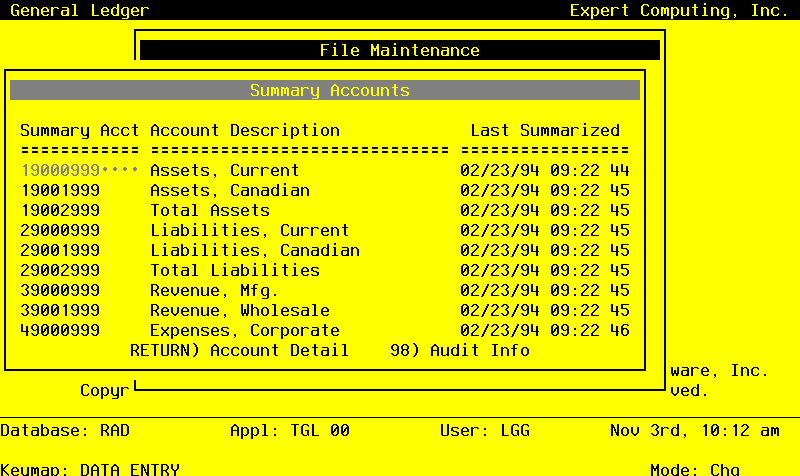
When the key value for a particular record is requested, you can review all the records in the file by selecting the Scan option. The records will be presented on an “Access” screen, and you will be allowed to scan the available data until you find the record you want. Then, position the cursor by that record and press ENTER; the record will be displayed for editing.
Note that the Audit Info option is available at the bottom of this screen. When this option is invoked, the Audit Information overlay appears and displays the date the record was created and who created it, as well as the date the record was last modified and who modified it. Press the END key or the RETURN key to clear the overlay from your screen. The information displayed in the Audit Information overlay is system-supplied and non-modifiable.
Data items for the preceding screen are described below:
- Summary Account
Upper case, up to 12 characters Required Scan available Scan by this field (access key)
Identify the summary account. This entry must be a valid account number with Summary? = ‘Y’. The system displays the description so that you can verify your entry.
- Last Summarized
Date and time (YMDHMS) Display only
The date of the last summary update is displayed.
The entered data is validated. During validation, including access to other files, conditions may be found which cause messages to be displayed. Errors (E), Warnings (W), and Messages (M) that may result are shown below:
Press ENTER to display system-supplied information and then press ENTER again to continue to the next screen.
Select the Next Record option to go to the next Summary Accounts record.
At this screen, the use of the MODE keys - ADD, DEL, CHG, or INQ - pertain to those records in the Summary Accounts file.
The screen shown below presents information about Summary Account Detail.
This file defines which accounts will be summed into the summary account. The current balance for each summary account is recalculated each time the Summarize Accounts function is selected from the Monthly Processing menu.
A summary account may need to be defined as the sum of two or more ranges of accounts. Each range requires a unique sequence number. Within each range of sequential accounts you may specify starting and ending constraints on one or more account components.
You should not define a summary account that includes other summary accounts.\
Summary Account Detail screen
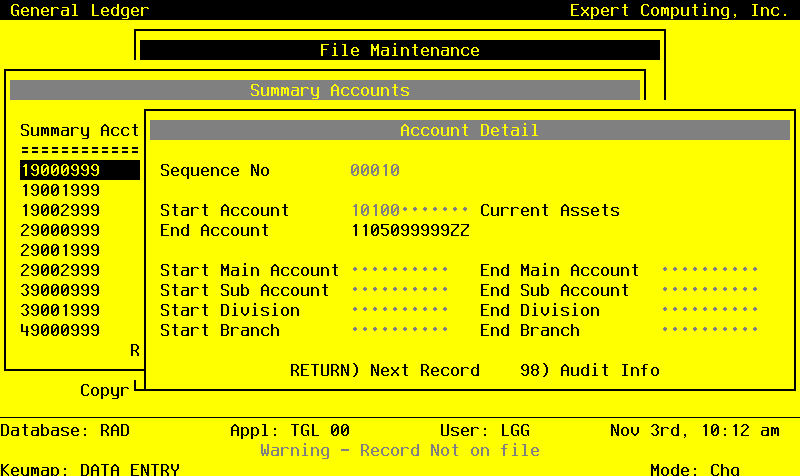
When the key value for a particular record is requested, you can review all the records in the file by selecting the Scan option. The records will be presented on an “Access” screen, and you will be allowed to scan the available data until you find the record you want. Then, position the cursor by that record and press ENTER; the record will be displayed for editing.
Data items for the preceding screen are described below:
- Sequence No
Positive number, up to 5 digits
The system assigns a sequential number to the first record of each summary account established. If mor than one range of accounts is to be included in the summary, this sequence is incremented by ten for each additional range.
- Start/End Account
Upper case, up to 12 characters Required Scan available
Supply the account number of the first and last account of the range to be included in the summary. The system displays the description so that you can verify your entry.
- Start/End Main Account
Upper case, up to 10 characters
Define the low and high values for the first component of the account if you want only certain first components included in the account range entered above. This field may be left blank.
- Start/End Sub Account
Upper case, up to 10 characters
Define the low and high values for the second component of the account if you want only certain second components included in the account range entered above. This field may be left blank.
- Start/End Division
Upper case, up to 10 characters
Define the low and high values for the third component of the account if you want only certain third components included in the account range entered above. This field may be left blank.
- Start/End Branch
Upper case, up to 10 characters
Define the low and high values for the fourth component of the account if you want only certain fourth components included in the account range entered above. This field may be left blank.
The entered data is validated. During validation, including access to other files, conditions may be found which cause messages to be displayed. Errors (E), Warnings (W), and Messages (M) that may result are shown below:
Press ENTER to display system-supplied information and then press ENTER again to save the information on this screen.
Select the Previous Image option to go back to the Summary Accounts screen. Select the Next Record option to go to the next Summary Account Detail record. Select the End option to go to the next Summary Accounts record.
At this screen, the use of the MODE keys - ADD, DEL, CHG, or INQ - pertain to those records in the Summary Account Detail file.