
2Initial Setup Opening Entries
Option 4Chart of Accounts
You can use this function to perform normal maintenance on the Chart of Accounts. In the Initial Setup phase of your operations, you can also enter monthly balances, as well as start-of-year, end-of-year, Source, Use, and Neither amounts.
When you use this function, a record of all entries will be printed. For additions, all new field contents are printed; for deletions, the deleted record’s contents are shown; for changes, both old field contents and new field contents are shown; and in all cases, the User ID, date, and time are printed.
The screen shown below presents information about the Chart of Accounts.
This file contains basic information about each account, such as its description, subsidiary type, currency code, and the level of detail to keep.
Initial Setup Chart of Accounts screen
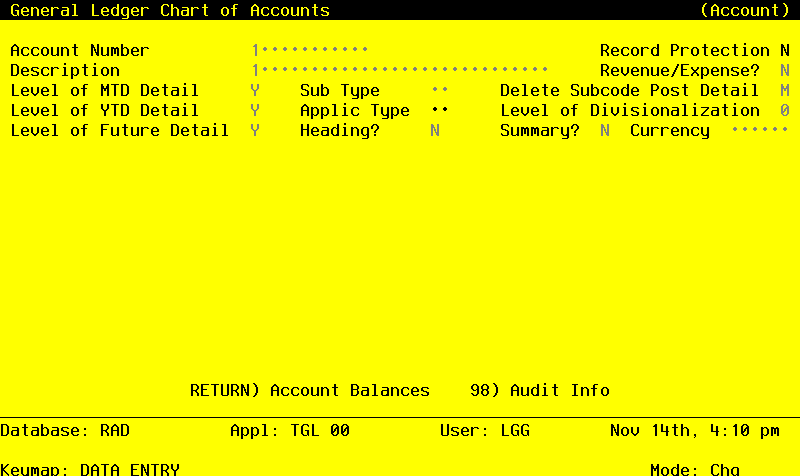
When the key value for a particular record is requested, you can review all the records in the file by selecting the Scan option. The records will be presented on an “Access” screen, and you will be allowed to scan the available data until you find the record you want. Then, position the cursor by that record and press ENTER; the record will be displayed for editing.
Note that the Audit Info option is available at the bottom of this screen. When this option is invoked, the Audit Information overlay appears and displays the date the record was created and who created it, as well as the date the record was last modified and who modified it. Press the END key or the RETURN key to clear the overlay from your screen. The information displayed in the Audit Information overlay is system-supplied and non-modifiable.
Data items for the preceding screen are described below:
- Account Number
Upper case, up to 12 characters Required Scan by this field (access key)
This number will be used in all accounting applications to identify this amount.
- Record Protection
Y or N
This field prevents accidental deletion of a record or changing of the key to this file.
- Description
Alphanumeric, up to 30 characters Required
Describe this account. This description will generally appear next to the account number field whenever it is displayed on other screens and reports.
- Revenue/Expense?
Y or N Required
This field designates whether the account is classified as a Balance Sheet account or a Revenue/Expense account.
- N
- Designates a Balance Sheet account (when changed, will not impact Current Earnings)
- Y
- Designates a Revenue/Expense account (when changed, will impact Current Earnings)
- Level of MTD Detail
Upper case, 1 character Letters only Valid: Y, S, J, O, D Default Y Required Carries forward in ADD mode
Describe the amount of detail to be kept on the Month to Date Postings file for this account. In order of “lease detail” to “most detail”, your options are:
- S
- Keep a summary by fiscal month and year
- J
- Keep a summary by fiscal month and year for each journal code
- O
- Keep a summary by fiscal month and year, journal code, and operator ID
- D
- Keep a summary by fiscal month and year, journal code, operator ID, and date
- Y
- Keep all detail
- Sub Type
Upper case, up to 2 characters Letters only
An entry of ‘GL’ indicates General Subsidiary.
Enter the cost accounting subsidiary to which this account is posted. If this is a General Subsidiary account, enter ‘GL’. For more information regarding General Subsidiary, refer to the “Application Features” section of this manual.
- Delete Subcode Post Detail
Upper case, 1 character Letters only Valid: N, M, Y, T Default M
For accounts with a Sub Type of ‘GL’, this entry indicates how often General Subsidiary detail postings are deleted from the subsidiary postings file. Your options are:
- N
- Never
- M
- Delete during Close Month processing each month
- Y
- Delete only at the end of the fiscal year
- T
- Delete at the end of this month
- NOTE
- An entry of ‘T’ in this field will be reset to ‘N’ after the detail has been deleted.
- Level of YTD Detail
Upper case, 1 character Letters only Valid: N, Y, S, J, O, D Default N Required Carries forward in ADD mode
Describe the amount of detail to be kept on the Year-to-Date Postings file for this account. In order of “lease detail” to “most detail”, your options are:
- N
- Do not keep any information
- S
- Keep a summary by fiscal month and year
- J
- Keep a summary by fiscal month and year for each journal code
- O
- Keep a summary by fiscal month and year, journal code, and operator ID
- D
- Keep a summary by fiscal month and year, journal code, operator ID, and date
- Y
- Keep all detail
- Application Type
Upper case, up to 2 characters Letters only Valid: GL, AR, AP, PA, IC, FA
If entered, Application Types are used to validate account numbers against each application’s “OK Applications”, which re defined in the Parameters file of each application. For example, you might define your expense accounts as having an application type of AP, for Accounts Payable, and your revenue accounts as having an application type of AR, for Accounts Receivable. If you then indicated in Accounts Payable that ‘AP’ was an OK Application type, but not ‘AR’, the system would prevent you from inadvertently entering a revenue account on an Accounts Payable invoice.
Accounts Payable that ‘AP’ was an OK Application type, but not ‘AR’, the system would prevent you from inadvertently entering a revenue account on an Accounts Payable invoice.
- Level of Divisionalization
Upper case, 1 character Numbers only Valid: 0, 1, 2 Default 0 Required Carries forward in ADD mode
This entry indicates what sub-account level of posting detail is to be made to this account. In applications which use the option of divisionalized accounting, postings to an account can select from three options of sub-account usage from the offset account. These options control the appending of account components from the offset account to the primary posting account. For any account with non-blank sub-accounts, the level of posting detail must be zero. The default value is zero. Your options are:
- 0
- Do not append any account components
- 1
- Append third component (account must have blank third and fourth components)
- 2
- Append third and fourth components (account must have blank third and fourth components)
- Level of Future Detail
Upper case, 1 character Letters only Valid: Y, S, J, O, D Default Y Required
Describe the amount of detail to be kept on the Future Postings file for this account. In order of “lease detail” to “most detail”, your options are:
- S
- Keep a summary by fiscal month and year
- J
- Keep a summary by fiscal month and year for each journal code
- O
- Keep a summary by fiscal month and year, journal code, and operator ID
- D
- Keep a summary by fiscal month and year, journal code, operator ID, and date
- Y
- Keep all detail
NOTE: All entries containing an intercompany code or a subsidiary code will be kept in detail. Also, be sure to keep at lease as much detail on your Futures file as you want to maintain on your MTD or YTD files for given account.
- Heading Account?
Y or N Default N Required
Enter ‘Y’ if this account represents a heading account. Heading accounts are used to format financial statements, and for separating accounts on the Trial Balance report and Chart of Accounts list. They contain no actual data and will never have any amounts posted to them. An example might be “Current Assets”.
- Summary Account?
Y or N Default N Required
Enter ‘Y’ if this is a summary account. Summary Accounts represent the total, or sum, of a grouping of other account balances. They will never have amounts posted directly to them; they are updated only when the “Summarize Accounts” function on the Monthly Processing menu is selected. An example of a summary account might be “Total Expenses”, which could be defined as the sum of all expense accounts.
You must also enter summary accounts into the Summary Accounts file.
- Currency
Alphanumeric, up to 6 characters Scan available
If entered, this code is verified against the General ledger Exchange Rates master file. This code identifies the currency in which these balances are maintained. For each record that is entered with a non-blank currency, an equivalent record must be added to the Foreign Balances file, since each foreign balance amount is maintained by the system in both foreign and home (domestic) currency amounts. An example might be Accounts Payable - Canadian Dollars.
The entered data is validated. During validation, including access to other files, conditions may be found which cause messages to be displayed. Errors (E), Warnings (W), and Messages (M) that may result are shown below:
Press ENTER to continue to the next screen.
Select the Next Record option to go to the next Chart of Accounts record.
At this screen, the use of the MODE keys - ADD, DEL, CHG, or INQ - pertain to those records in the Chart of Accounts file.
The screen shown below presents information about Account Balances.
During the Initial Setup phase of your operations, you can use this screen to enter your opening account balances. During Live Operations, you will not see this screen.
This file contains monthly summaries of postings for each account by fiscal year. It also contains startof-year (SOY), end-of-year (EOY, and year-to-date Sources (normally credits) and uses (normally debits) amounts.
Initial Setup Account Balances - Enter screen

When the key value for a particular record is requested, you can review all the records in the file by selecting the Scan option. The records will be presented on an “Access” screen, and you will be allowed to scan the available data until you find the record you want. Then, position the cursor by that record and press ENTER; the record will be displayed for editing.
Data items for the preceding screen are described below:
- Fiscal Year
Positive number, up to 2 digits
Identify the fiscal year for which balances are to be entered.
- SOY
Number, up to 9 digits and 2 decimals
Identify the start-of-year balance.
- Monthly Balances
Number, up to 9 digits and 2 decimals
Identify the balance for each fiscal month. Thirteen months are allowed.
- EOY
Number, up to 9 digits and 2 decimals
Identify the end-of-year balance.
- MTD Sources
Number, up to 9 digits and 2 decimals
All Credit transactions are normally posted into this field on a month-to-date basis, unless they are identified in transaction entry as adjustments, in which case they reduce Uses instead.
- MTD Uses
Number, up to 9 digits and 2 decimals
All Debit transactions are normally posted into this field on a month-to-date basis, unless they are identified in transaction entry as adjustments, in which case they reduce Sources instead.
- MTD Neither
Number, up to 9 digits and 2 decimals
All t transactions identified as “Neither” in transaction entry are posted into this field on a month-to-date basis.
- YTD Sources
Number, up to 9 digits and 2 decimals
All Credit transactions are normally posted into this field on a year-to-date basis, unless they are identified in transaction entry as adjustments, in which case they reduce Uses instead.
- YTD Uses
Number, up to 9 digits and 2 decimals
All Debit transactions are normally posted into this field on a year-to-date basis, unless they are identified in transaction entry as adjustments, in which case they reduce Sources instead.
- YTD Neither
Number, up to 9 digits and 2 decimals
All transactions identified as “Neither” in transaction entry are posted into this field on a year-to-date basis.
The entered data is validated. During validation, including access to other files, conditions may be found which cause messages to be displayed. Errors (E), Warnings (W), and Messages (M) that may result are shown below:
Press ENTER to display system-supplied information and then press ENTER again to continue to the next screen.
Select the Previous Image option to go back to the Chart of Accounts screen. Select the Next Record option to go to the next Account Balances record. Select the End option to go to the next Chart of Accounts record.
At this screen, the use of the MODE keys - ADD, DEL, CHG, or INQ - pertain to those records in the Account Balances file.
The screen may optionally be used to display information about Account Balances.
During the Initial Setup phase of your operations, you will not see this screen. During Live Operations, you can view your account balances using this screen.
Initial Setup Account Balances Display screen
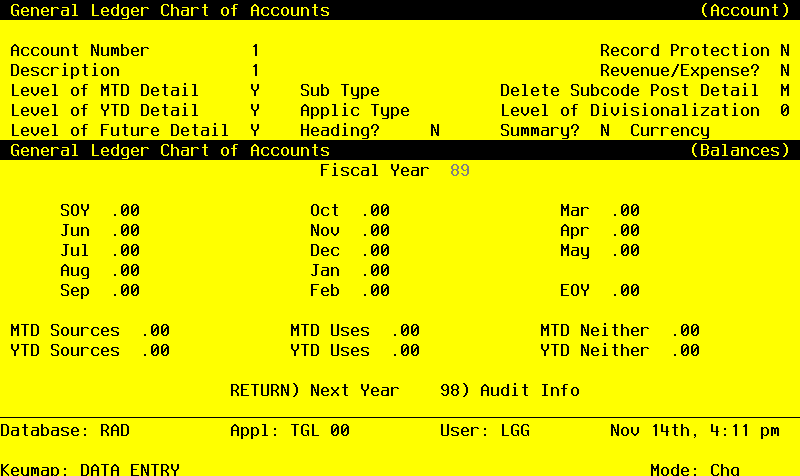
When the key value for a particular record is requested, you can review all the records in the file by selecting the Scan option. The records will be presented on an “Access” screen, and you will be allowed to scan the available data until you find the record you want. Then, position the cursor by that record and press ENTER; the record will be displayed for editing.
Data items for the preceding screen are described below:
- Fiscal Year
Positive number, up to 2 digits
Identify the fiscal year for which balances are to be entered.
- SOY
Number, up to 9 digits and 2 decimals Display only
Identify the start-of-year balance.
- Monthly Balances
Number, up to 9 digits and 2 decimals Display only
Identify the balance for each fiscal month. Thirteen months are allowed.
- EOY
Number, up to 9 digits and 2 decimals Display only
Identify the end-of-year balance.
- MTD Sources
Number, up to 9 digits and 2 decimals Display only
All Credit transactions are normally posted into this field on a month-to-date basis, unless they are identified in transaction entry as adjustments, in which case they reduce Uses instead.
- MTD Uses
Number, up to 9 digits and 2 decimals Display only
All Debit transactions are normally posted into this field on a month-to-date basis, unless they are identified in transaction entry as adjustments, in which case they reduce Sources instead.
- MTD Neither
Number, up to 9 digits and 2 decimals Display only
All transactions identified as “Neither” in transaction entry are posted into this field on a month-to-date basis.
- YTD Sources
Number, up to 9 digits and 2 decimals Display only
All Credit transactions are normally posted into this field on a year-to-date basis, unless they are identified in transaction entry as adjustments, in which case they reduce Uses instead.
- YTD Uses
Number, up to 9 digits and 2 decimals Display only
All Debit transactions are normally posted into this field on a year-to-date basis, unless they are identified in transaction entry as adjustments, in which case they reduce Sources instead.
- YTD Neither
Number, up to 9 digits and 2 decimals Display only
All transactions identified as “Neither” in transaction entry are posted into this field on a year-to-date basis.
The entered data is validated. During validation, including access to other files, conditions may be found which cause messages to be displayed. Errors (E), Warnings (W), and Messages (M) that may result are shown below:
Press ENTER to display system-supplied information and then press ENTER again to continue to the next screen.
Select the Previous Image option to go back to the Chart of Accounts screen. Select the Next Record option to go to the next Account Balances record. Select the End option to go to the next Chart of Accounts record.
At this screen, the use of the MODE keys - ADD, DEL, CHG, or INQ - pertain to those records in the Account Balances file.