
Chapter 4: Recovery Processing
Options 8- Recurring Billings
Use this function to enter and edit Recurring Billings records, and to define the line items that make up each recurring billing.
When you use this function, a record of all entries will be printed. For additions, all new field contents are printed; for deletions, the deleted record’s contents are shown; for changes, both old field contents and new field contents are shown; and in all cases, the User ID, date, and time are printed.
The screen shown below presents information about Recurring Billings.
This file defines invoice entries to be automatically generated within the invoice transaction files every month when the Generate Recurring Billings function is run.
Recovery Processing Recurring Billings screen
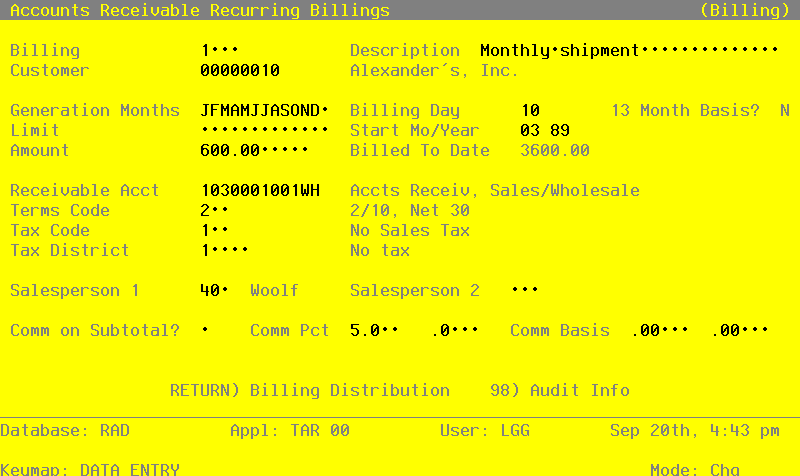
When the key value for a particular record is requested, you can review all the records in the file by selecting the Scan option. The records will be presented on an “Access” screen, and you will be allowed to scan the available data until you find the record you want. then, position the cursor by that record and press ENTER; the record will be displayed for editing.
Note that the Audit Info option is available at the bottom of this screen. When this option is invoked, the Audit Information overlay appears and displays the date the record was created and who created it, as well as the date the record was last modified and who modified it. Press the END key or the RETURN key to clear the overlay from your screen. The information displayed in the Audit Information overlay is system-supplied and non-modifiable.
Data items for the preceding screen are described below:
- Billing
Positive number, up to 4 digits Scan by this field (access key)
The system automatically displays the next available number beginning with ‘1’. You may enter your own unique number of up to 4 digits or accept the default.
- Description
Alphanumeric, up to 30 characters
Describe this recurring billing.
- Customer
Upper case, up to 8 characters Numbers only Scan available
Identify the customer who receives this recurring billing. This number must be on file in the customers file. the system displays the customer name so that you can verify your entry.
- Generation Months
Alphanumeric, up to 13 characters Letters only Default JFMAMJJASONDT
Each of these letters represents the name of a month. If you are set up on a 13-period year in the Parameters file, a “t” appears after the last month to identify the 13th period.
Delete the characters of all months during which you do not want to generate a recurring billing. For example, if you want to generate a recurring billing every “odd” month, you would remove the even-month characters. The field would look like this:
Generation Months J M M J S N
- Billing Day
Positive number, up to 2 digits
Supply the date used on the invoice. Depending on the entry in the 13 Month Basis? field, the Billing Day specifies either the day of the month or the day of the period.
If 13 Month Basis? is ‘Y’, the billing Day pertains to a 28-day accounting period, and the system calculates the actual calendar date. For example, suppose that you are currently in the second calendar period of the year. if you entered a ‘2’ for billing Day, the ‘2’ would represent January 30th, since this date is the second day in the calendar period.
If 13 Month Basis? is ‘N’, the Billing Day is the day of the calendar month. For example, suppose you entered a ‘2’ for billing Day, and you are currently in February. The ‘2’ would represent February 2nd, since this date is the second day in the calendar month.
- 13 Month Basis?
Y or N Required
the initial default value is ‘N’.
The system displays ‘Y’ or ‘N’ to indicate whether or not the Billing Day is based on a 13month accounting period. this field works in conjunction with the Billing Day field on this screen. If your system is on a 12-month fiscal year (see Parameters field), this field is automatically set to ‘N’ and cannot be changed. If your system is on a 13-month fiscal year, the entries are either:
Y: The recurring billing generation is based on a 13-period fiscal year. In this case, the billing Day field corresponds to a day in the 28-day accounting period. For example, a Billing Day of ‘10’ means that payment should occur on the 10th day of the accounting period.
- N
- The recurring billing generation is based on a 12-month fiscal year. In this case, the billing Day field corresponds to a day in the month.
- Limit
Number, up to 9 digits and 2 decimals
Specify the maximum dollar amount that may be generated by this recurring billing. a billing will not be generated once the Billed to Date field reaches this limit. If this field is left blank, the recurring billing is unlimited. In the event that a partial billing is generate due to reaching the limit, the line items are prorated to reflect the partial bill.
- Start Month
Upper case, up to 2 characters Letters and numbers only Valid: 01, 02, 03, 04, 05, 06, 07, 08, 09, 1, 11, 12, 13, EY Required
Identify the calendar month and year of the first month for which you want to generate invoices for this recurring billing.
- Start Year
Positive number, up to 2 digits
In ADD ,mode, this field will automatically be saved from one record to the next.
Supply the first calendar year for which you want to generate invoices for this recurring billing.
- Amount
Number, up to 7 digits and 2 decimals
Supply the dollar amount to be debited or credited to the receivable account for this recurring billing. Enter a negative amount for a credit entry.
- Billed to Date
Number, up to 9 digits and 2 decimals
During Initial Setup you can enter the total dollar amount that has been billed to date for this recurring billing. During Live Operations, the system maintains and displays the total amount that has been Billed to Date for this recurring billing. this field is used with the Limit field to control the recurring billing generation.
- Receivable Account
Upper case, up to 12 characters Required Scan available
The system displays the receivable account set up for this customer; you can enter a new receivable account. If General ledger is part of your system, the account number you enter must be on file, and the system displays the description from that file so that you can verify your entry.
- Terms Code
Positive number, up to 3 digits Scan available
The system displays the terms code entered on the Customers record; you can enter a new terms code if you choose. the code you enter must be on file in the Terms file, and the system displays the description of your entry for verification.
- Tax Code
Positive number, up to 3 digits Scan available
The system displays the Tax code entered on the Customers record. You can override the display. The system displays the corresponding description Os that you can verify your entry.
- Tax District
Alphanumeric, up to 5 characters Scan available
The system displays the Tax District entered on the Customers record. You can override the display. The system displays the corresponding description Os that you can verify your entry. The tax district must be valid for the Tax Code you entered.
- Salespersons
Positive number, up to 3 digits Scan available
If your system includes commission Accounting, you may identify one or two sales persons to receive credit for the sale. These entries must be on file in the Salespersons file. The system displays the corresponding Alpha entry from that file so that you can verify your entry.
If your system does not include commission Accounting, you can make an entry here for your information.
- Comm on Subtotal?
Y or N
Specify the base on which commissions are to be calculated. Y: the invoice subtotal amount
- N
- The line item amounts
Leave this field blank if commissions will not be calculated.
- Comm Pct
Positive number, up to 3 digits and 1 decimals
This field specifies the percentage base used to calculate the commission earned by each sales person you entered.
If your system includes Commission Accounting, the system displays the Commission Percent from the Salesperson record for each salesperson that you entered. You can override the display.
If your system does not include Commission Accounting, you can make an entry here for your information.
- Comm Basis
Positive number, up to 3 digits and 2 decimals
Supply the percentage of the commissionable dollars that each salesperson is allocated for this invoice. This percentage is applied either to the Subtotal or to each line item, depending on the entry in the Comm on Subtotal? field.
If the commission is split between two salespeople, the first entry should be the percentage of the sales used to calculate the first salesperson’s commission, and the second should be the percentage used to calculate the second salesperson’s commission.
If commission Accounting is part of the system, the first entry defaults to ‘100’ and the second to ‘0’. You can override these defaults.
These entries do not need to add up to 100. Any underage or overage will be posted to the “House Account” in Commission Accounting.
The entered data is validated. during validation, including access to other fields, conditions may be found which cause messages to be displayed. Errors (e), Warnings (W), and Messages (M) that may result are shown below:
Press ENTER to display system-supplied information and then press ENTER again to continue to the next screen.
Select the Next Record option to go to the next Recurring Billings record.
At this screen, the use of the MODE keys - ADD, DEL, CHG, or INQ - pertain to those records in the Recurring Billings file.
The screen shown below presents information about Recurring Line Items.
This file defines invoice line items to be automatically generated within the invoice transaction file every month when the Generate Recurring billings function is run.
Recovery Processing Recurring Line Items screen
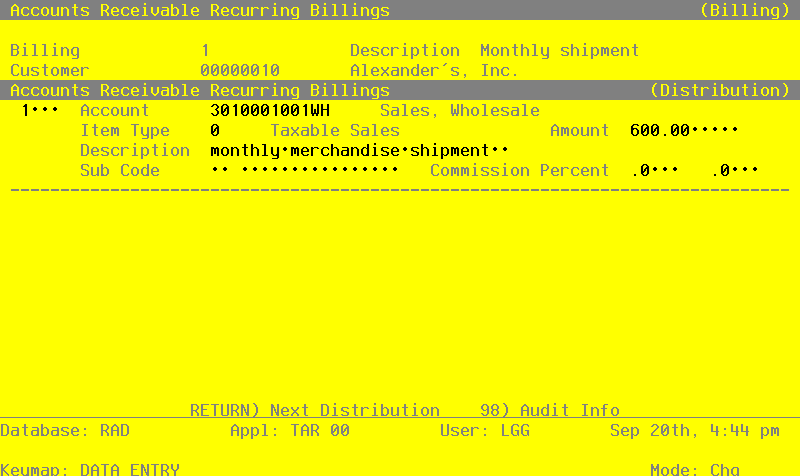
When the key value for a particular record is requested, you can review all the records in the file by selecting the Scan option. the records will be presented on an “Access” screen, and you will be allowed to scan the available data until you find the record you want. then, position the cursor by that record and press ENTER; the record will be displayed for editing.
Data items for the preceding screen are described below:
- Line Item Number
Positive number, up to 4 digits
Identify the line item number. You may enter line items in any sequence. The system automatically starts with ‘1’, and sorts them into numerical order when you complete the screen entry.
- Account
Upper case, up to 12 characters Required Scan available
The Offset Account from the Customer record is supplied; you may change it. If your system includes General Ledger, the account you enter must be on file in the chart of Accounts field, and the system displays the account description from that file so that you can verify your entry.
- Item Type
Positive number, 1 digit
Identify the type of this line item. The system displays the description so that you can verify your entry. Valid codes are:
- 0
- Taxable sale
- 1
- Nontaxable sale
- 2
- Customer discount
- 3
- Freight
- 4
- Sales tax
- 5
- Other
- Amount
Number, up to 7 digits and 2 decimals
Identify the amount to be debited or credited fro this recurring billing line item. A positive amount is considered a credit; fro a discount line item, enter a negative amount.
- Description
Alphanumeric, up to 30 characters
Describe this recurring line item.
- Sub Type
Upper case, up to 2 characters Letters only
The system displays the subsidiary type for the account, as defined in General Ledger. This reflects the subsidiary to which this line item will be posted.
If General Ledger is not part of your system, you may enter any value in this field. The transactions that are posted to various subsidiary types and codes can be printed on the Subsidiary Codes GL Distributions report on the Monthly Processing menu.
- Sub Code
Upper case, up to 16 characters Scan available
Supply s subsidiary code if this line item is to be posted to a subsidiary costing application. If the sub type is ‘GL’, it is assumed that the transaction will flow through to General Subsidiary. You cannot enter a subsidiary code if the subsidiary type is blank; conversely, if the subsidiary type is not blank you must enter a subsidiary code.
The transactions that are posted with the various subsidiary types and codes can be viewed on the subsidiary Code GL Distributions report on the Monthly Processing menu.
- Commission Percent
Positive number, up to 3 digits and 1 decimals
If you entered ‘N’ for Comm on Subtotal? on the previous screen, enter the commission percent(s) to be paid on this line item. This field is optional.
If your system does not include Commission Accounting, you can make an entry here for your information.
The entered data is validated. During validation, including access to other files, conditions may be found which cause messages to be displayed. Errors (E), Warnings (W), and Messages (M) that may result are shown below:
Press ENTER to display system-supplied information and then press ENTER again to save the information on this screen.
Select the Previous Image option to go back to the Recurring Billings screen. Select the Next Record option to go to the next Recurring Billings Line Items record. Select the End option to go to the next Recurring billings record.
At this screen, the use of the MODE keys - ADD, DEL, CHG, or INQ - pertain to those records in the Recurring Billings Line Items file.