
Chapter 4: Maintenance
Types File Maintenance
Use this function to enter or edit budget and/or unit types. For example, for Budget Types you may want to differentiate between several sets of budgets such as "Proposed", "Revision 1", and "Revision 2". For Unit Types you may need to track unit balances separately for "Machine Hrs" and "Man Hours".
Budget and unit types are used in conjunction with the Budgets and Units files (as maintained in Budgets File Maintenance and Unit Accounts File Maintenance). Each account may have multiple budget or unit versions, or "types". This file identifies and differentiates those types.
The Budget & Unit Types Screen, shown in Figure 4-6 below, appears when you select Types from the File Maintenance Pulldown Menu. You normally enter this function in Inquire mode but you can change mode by using the mode icons on the toolbar or the mode function keys. Since Change mode places a hold on the selected record, use Change mode only when you intend to change data. If desired, in key entry, you can click on  or press the Scan key to review the records currently on file and select one for editing or viewing.
Budget & Unit Types screen
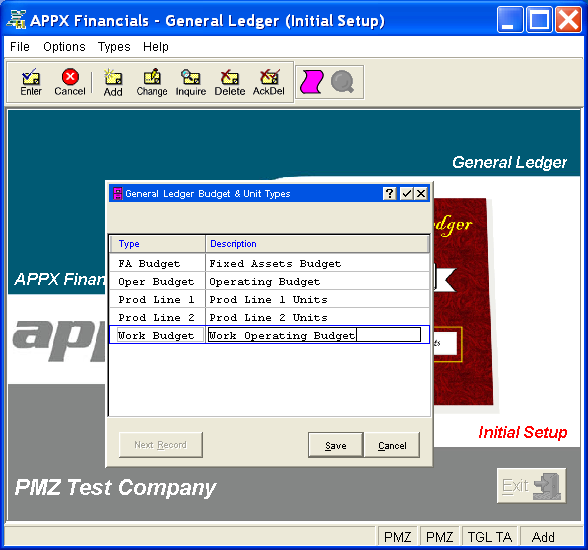
This is a scrolling screen which contains the following fields for each record:
- Type
Enter a unique code for this budget or unit type, up to 12 characters in length.
- Description
Enter a description for the budget or unit type, up to 30 characters in length.
Press ENTER or click  or the Save button to save the information for the current record. If any information has changed, the system may redisplay the screen to report any error or warning messages. If so, the current record has not yet been saved; you must address any concerns and press ENTER or click or the Save button again. To exit without saving, press END or click
  or the Cancel button.
The following icons are also available for use on the toolbar (unless disabled in Add mode or until a record has been selected):
 List Budget & Unit Types: See Types List for further information.
 Display Type Audit Info: See Audit Info for further information.
Click the appropriate icon to perform the desired operation (which first saves the current record if applicable), after which you will return to where you are.