
Chapter 7: The Exceptions File
Defining Exceptions via the Exception File Input Processes
Four Input Processes can be found on the Application Language Translation Menu (see Figure 8). Each of them provide you with a means of going through all of the application’s processes, files, fields, or domains in sequential order to define or maintain exceptions. Using Figure 15, determine what components exceptions can be defined for in each of the four Exception File Input Processes.
| Exception File Inputs | Components Exceptions Can Be Made For |
|---|---|
| Processes |
|
| Files |
|
| Fields |
|
| Domains |
|
To define exceptions using the Exceptions File Input Processes, follow these steps:
- On the application’s Language Translator Menu, select the process under File Maintenance that corresponds to the exceptions you want to make.
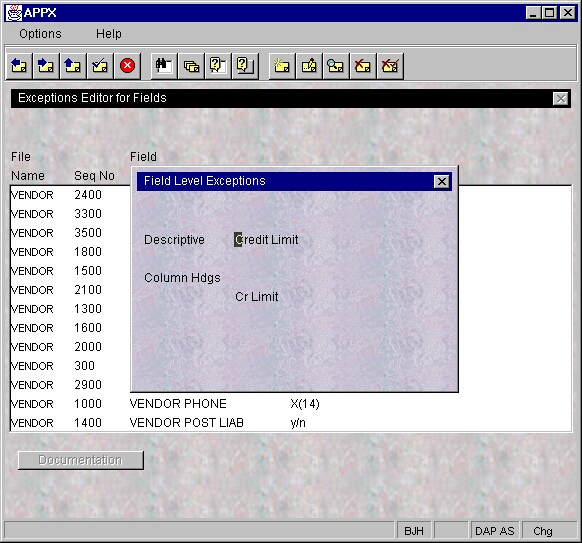
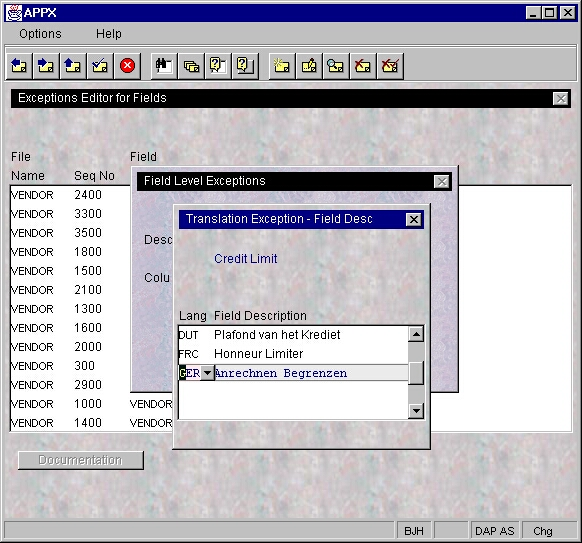
- The process displays a list of design processes, domains, fields, or domains depending on the input process you are running. From this scrolling display, each process has different options in the form of buttons that are available at the bottom of the screen.
- Documentation
Displays the User Documentation in the Design Language for this process, file, field, or domain. Click this button if you want to define User Documentation exceptions.
- Process Fields
Displays the In Progress Message and Report Title in the Design Language for processes. Click this button if you want to define exceptions for either process field.
OR
Press ENTER to drill down to an image (for Processes) or to display the Field Description and Column Headings (for Fields and Domains). You must display the fields prior to defining exceptions for them. See Figure 16.
- When you are positioned at the field--or within a row of image text-- you want to define an exception for, select
OPTION 95 (OPTION, OPTION, 9, 5). This option initiates the Exceptions File Editor. - If you are defining an exception for a row or partial row of image text, the editor instructs you to move the cursor to the last character in the string of text (or row) you are defining an exception for. See Figure 18. Move the cursor to the end of the string or row and press
ENTER. If you are not defining an exception for a row or partial row, skip this step. - The editor needs to know the Presentation Language you are defining the exception for. Enter the Language ID (or click ▼ to select from a drop-down list) then press
ENTERtwice. - Select the appropriate Mode (
ADD MODE,CHANGE MODEorDELETE MODE) depending on whether you want to add a new exception, change an existing one, or delete an unnecessary one. - Type the exception’s translation in the presentation language you indicated. The exception can also be modified or deleted at this point.
- When finished, press ENTER to save the translation (or
ACKNOWLEDGE DELETEto delete it). - Enter translations in additional Presentation Languages, pressing
ENTERafter each. See Figure 17. Or, you can modify/delete existing exceptions. - When all translations are defined, modified or deleted for this field or image, select
ENDuntil you return to the scrolling display of processes, files, fields, or domains.