
Chapter 3: Recovery Processing
Option 3Products by Warehouse
This Recovery Processing function allows changes to be made to Products by Warehouse records which cannot be accessed during Live Operations.
When you use this function, a record of all entries will be printed. For additions, all new field contents are printed; for deletions, the deleted record’s contents are shown; for changes, both old field contents and new field contents are shown; and in all cases, the User ID, date, and time are printed.
The screen shown below presents information about Products by Warehouse.
Recovery Processing Products by Warehouse screen, part 1 of 2
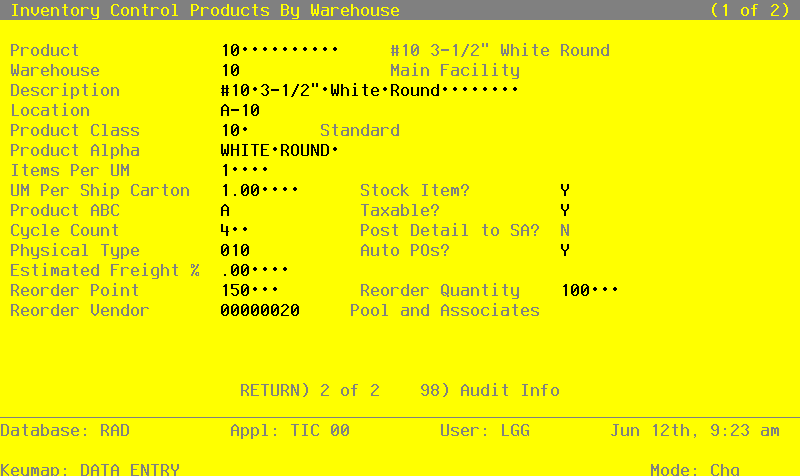
When the key value for a particular record is requested, you can review all the records in the file by selecting the Scan option. The records will be presented on an “Access” screen, and you will be allowed to scan the available data until you find the record you want. Then, position the cursor by that record and press ENTER; the record will be displayed for editing.
Data items for the preceding screen are described below:
- Product
Enter the product number from the Products file to be set up on the Product By Warehouse record. You can use the Scan option to find an appropriate entry. The system displays the corresponding description so that you can verify your entry.
- Warehouse
Enter the number from the Warehouses file that identifies a warehouse carrying the product. You can use the Scan option to find an appropriate entry. The system displays the corresponding description so that you can verify your entry.
You must establish a separate record for each product/warehouse combination.
- Description
Enter up to 30 characters to describe the product/warehouse combination.
- Location
Enter up to 4 characters to specify the location of the product in the warehouse.
Product locations are printed on physical count sheets to aid in taking physical inventories.
- Product Class
The system displays the product class number for this product from the Products file. You can enter a new product class to override the display. The description from the Product Classes file is displayed so that you can verify your entry.
- Product Alpha
The system displays the product alpha from the Products record. You can enter a new product alpha to override the display.
- Items Per UM
The system displays the Items Per UM entry from the Products record. You can enter up to 5 digits to override the display.
- UM Per Ship Carton
The system displays the UM Per Ship Carton entry from the Products record. You can enter up to 5 digits and 2 decimals to override the display.
- Stock Item?
The system displays the Stock Item? flag (‘Y’ or ‘N’) from the Products record. It may be changed.
- Product ABC
The system displays the Product ABC type entry from the Products record. It may be changed.
- Taxable?
The system displays the Taxable? flag (‘Y’ or ‘N’) from the Products record. It may be changed.
- Cycle Count
The system displays the Cycle Count entry from the Products record. You can enter a new cycle count of up to 2 digits to override the display.
- Post Detail to SA?
The system displays the Post Detail to SA? flag (‘Y’ or ‘N’) from the Products record. It may be changed.
- Physical Type
The system displays the Physical Type entry from the Products record. You can enter a new physical type of up to 3 characters to override the display.
- Auto POs?
Enter ‘Y’ or ‘N’ to specify whether or not the system will automatically create Inventory Control reorder records when the product reaches the reorder point at the warehouse. If you use this feature, Inventory Control must be part of the system.
- Y
- Reorder records will be created for the product when it reaches the reorder point.
N: Reorder records will not be created. Enter ‘N’ if Inventory Control is not part of the system. You can review, change, or delete reorder records at any time. The system uses reorder records to generate purchase orders. The entries you make in the Reorder Point, Reorder Quantity, and Reorder Vendor fields on this screen are used on the initial reorder record.
- Estimated Freight %
The system displays the Estimated Freight Percentage entry from the Products record. You can enter a new percentage of up to 3 digits and 2 decimals to override the display.
- Reorder Point
Enter up to 5 digits to identify the point at which the product should be reordered for this warehouse. The reorder point is the number of on hand stockkeeping units at which more product should be ordered.
- Reorder Quantity
Enter up to 5 digits for the number of stockkeeping units to be ordered when the reorder point is reached. The system converts the stockkeeping units entered here into purchasing units (using the Quantity Factor on the Product By Vendor record) for the reorder record.
- Reorder Vendor
Enter the 5-digit number from the Vendors file for the vendor to be used on reorders of this product. You can use the Scan option to find an appropriate entry. The system displays the vendor’s name on the screen so that you can verify your entry. You can leave this field blank if you do not know who the reorder vendor will be.
If the Auto POs? option is used in Inventory Control, the vendor is included on the automatic reorder record before it creates purchase orders. The vendor may be changed on the reorder record. If the Reorder Vendor field is left blank, the vendor name on the reorder record is blank; it can be entered after the record is created.
The entered data is validated. Press RETURN to continue.
Select Next Record to go to the next Products By Warehouse record.
At this screen, the use of the MODE keys — ADD, DEL, CHG, or INQ — pertain to those records in the Products By Warehouse file.
Below is the second Products By Warehouse screen.
Products By Warehouse screen, part 2 of 2
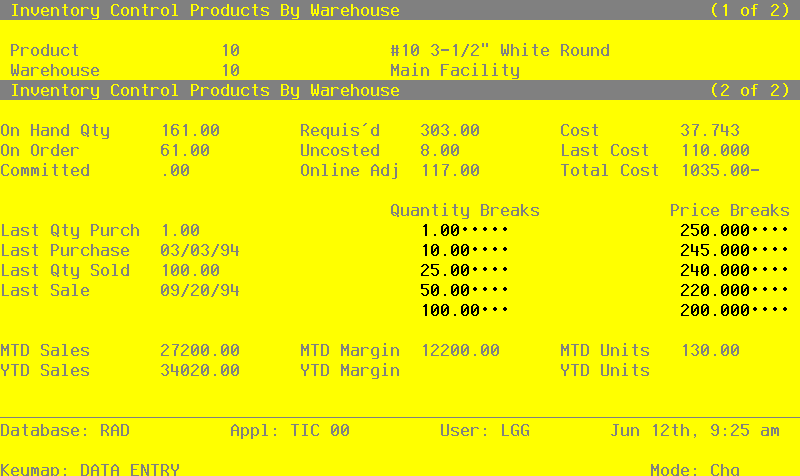
Certain entries on this screen will be automatically displayed. If an asterisk (*) appears next to one of the fields listed below, it indicates a “display-only” field, which cannot be changed.
Also, certain fields on the screen do not apply if the Inventory Control or Order Entry application is not part of the system. In this case, you do not need to make entries in these fields. An asterisk (*) appears next to these fields.
- Product*
The system displays the Product entry from the previous screen and the corresponding description.
- Warehouse*
The system displays the Warehouse entry from the previous screen and the corresponding description from the Warehouses file.
- On Hand Qty*
The system displays the number of stockkeeping units of the product that are on hand at the warehouse.
- Requis’d*
The system displays the number of stockkeeping units of the product that are requisitioned (in Inventory Control) for this warehouse.
- Cost*
The system displays the current unit cost of the product at this warehouse. The unit cost includes both the purchase price of the unit and any additional prorated costs applied to the cost of the product (for example, freight and tax).
- On Order*
The system displays the number of stockkeeping units of the product that are on order for this warehouse.
- Uncosted*
The system displays the number of stockkeeping units of the product that have been received but not yet invoiced (costed).
If the Inventory Control application is part of the system, Inventory Control transactions update this field on line.
- Last Cost*
The system displays the most recent unit cost of the product at the warehouse.
- Committed*
The system displays the number of stockkeeping units of the product that have been committed (sales orders not yet shipped) from this warehouse.
If the Order Entry application is part of the system, this field is updated by Sales Order Entry.
- Online Adj*
The system displays the number of stockkeeping units of the product that have been sold (and shipped) but not posted.
If the Order Entry application is part of the system, this field is updated by Sales Order Entry or Shipping Confirmation.
- Total Cost*
The system displays the total cost of all stockkeeping units on hand at this warehouse. For example, if 50 of these products are on hand at the warehouse, the system displays the combined cost of these 50 products.
Due to fluctuations in the Cost field, the Total Cost field should not be expected to contain a value equal to the quantity of the product multiplied by its current cost.
- Last Qty Purch*
The system displays the number of stockkeeping units of the product that were last purchased for this warehouse.
This field is updated during purchase order entry (on line) and during invoice posting.
- Last Purchase*
The system displays the date on which the product was last purchased for the warehouse.
During purchase order posting, this field is updated to the purchase order date. During invoice posting, this field is updated to the invoice date.
- Last Qty Sold*
The system displays the number of units of the product that were included in the last sale of the product from this warehouse. Invoice posting updates this field.
- Last Sale*
The system displays the date that the product was last sold from this warehouse.
- Quantity Breaks
You can enter up to 5 quantity/price breaks. The quantities for each price break are identified here. (The prices are entered in the column to the right.) Enter up to 5 digits and 2 decimals to identify each of the quantity breaks. Quantity/price breaks are used by the Order Entry application.
- Price Breaks
The prices for each quantity break are identified here. (The quantities are entered in the column to the left.) Enter up to 6 digits and 3 decimals to identify the selling price offered at each quantity break.
Here is a sample table of quantity and price breaks:
Quantity Breaks Price Breaks 1.00 15.000 100.00 13.000 10000.00 11.000
This table indicates the following pricing:
- Purchases of 1 to 99 units are priced at $15.00 per unit
- Purchases of 100 to 9,999 units are priced at $13.00 per unit
- Purchases of 10,000 units and up are priced at $11.00 per unit
- MTD Sales*
The system displays the month-to-date sales dollars earned on the product at this warehouse. This field is updated from Order Entry.
- MTD Margin*
The system displays the month-to-date sales margin (sales dollars less cost) for the product at this warehouse. This field is updated from Order Entry.
- MTD Units*
The system displays the number of units of the product that have been sold from this warehouse during the current month. This field is updated from Order Entry.
- YTD Sales*
The system displays the year-to-date sales dollars earned on the product at this warehouse. This field is updated from Order Entry.
- YTD Margin*
The system displays the year-to-date sales margin (sales dollars less cost) for the product at this warehouse. This field is updated from Order Entry.
- YTD Units*
The system displays the number of units of the product that have been sold at this warehouse during the current year. This field is updated from Order Entry.
The entered data is validated. Press RETURN to save the information on these screens.