
Chapter 3: Recovery Processing
Option 2Products
This Recovery Processing job allows maintenance of product records. Many of the values contained on the following entry screen will be changed automatically in the Products by Warehouse file when changed using this job.
When you use this function, a record of all entries will be printed. For additions, all new field contents are printed; for deletions, the deleted record’s contents are shown; for changes, both old field contents and new field contents are shown; and in all cases, the User ID, date, and time are printed.
The screen shown below presents information about Products.
Recovery Processing Products screen
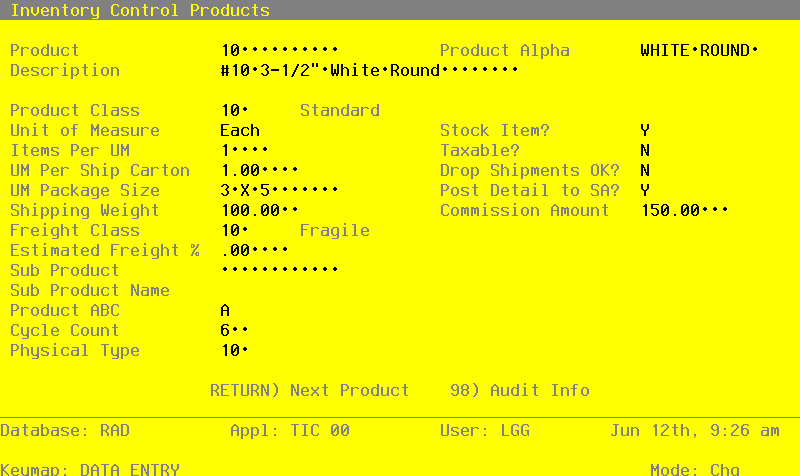
When the key value for a particular record is requested, you can review all the records in the file by selecting the Scan option. The records will be presented on an “Access” screen, and you will be allowed to scan the available data until you find the record you want. Then, position the cursor by that record and press ENTER; the record will be displayed for editing.
Data items for the preceding screen are described below:
- Product
Enter up to 12 characters to identify the product. This is the code that will be used to recall or reference this record elsewhere in the system.
- Product Alpha
Enter a unique code of up to 12 characters for this product. The code that you enter allows you to locate the product if you do not know the product number. Also, the system can use this code to sort data for reports.
If this field is changed, the system automatically changes this field on all Products By Warehouse and Products By Vendor records that include this product. Thus, you should change this field only if no purchase orders remain open or if you also plan to modify all related records through the appropriate File Maintenance functions.
- Description
Enter up to 30 characters to identify the product.
If this field is changed, the system automatically changes this field on all Products By Warehouse and Products By Vendor records that include this product. Thus, you should change this field only if no purchase orders remain open or if you also plan to modify all related records through the appropriate File Maintenance functions.
- Product Class
Enter the product class to which this product belongs. You can use the Scan option to find an appropriate entry. The product class you enter must be in the Product Classes file. The system displays the corresponding description so that you can verify your entry. The Product Classes record identifies the General Ledger accounts that are used for this product.
If this field is changed, the system automatically changes this field on all Products By Warehouse records that include this product. Posted purchase orders are not changed and would require an operator to manually change any affected General Ledger accounts on the purchase order.
- Unit of Measure
Enter up to 4 characters to describe the stockkeeping unit of measure used for the product as it is stored in inventory. For example, if shirts are stored by the package in inventory, you could enter ‘Pkg’ here.
This field is for your information only. It is occasionally displayed for reference on other records.
- Stock Item?
Enter ‘Y’ or ‘N’ to specify whether or not this is a regularly stocked product.
- Y
- This is a regularly stocked product. Sales invoices posted with this product number in the Product No field will reduce on hand quantities in inventory.
N: This is a nonstock product. A nonstock item does not have “on hand” quantities that can be reduced. You can also enter ‘N’ here for a service (for example, installation or repair). Sales invoices posted with this product number will not reduce on hand quantities.
- Items per UM
Enter up to 5 digits to specify the number of individual items included in the unit of measure. Using the example given for the Unit of Measure field, if each package (unit of measure) contains 3 shirts, you would enter ‘3’ here. This field is for your information only.
If this field is changed, the system automatically changes this field on all Products By Warehouse records that include this product.
- Taxable?
Enter ‘Y’ or ‘N’ to specify whether or not this product is subject to sales tax when sold. This field is used by the Order Entry and Accounts Receivable applications.
- Y
- This product is subject to sales tax.
N: This product is not subject to sales tax. If this field is changed, the system automatically changes this field on all Products By Warehouse records that include this product. Thus, you should change this field only if no purchase orders remain open or if you also plan to modify all related records through the appropriate File Maintenance functions.
- UM per Ship Carton
Enter up to 5 digits and 2 decimals for the number of units of measure in the shipping carton used for this product. Using the Unit of Measure example, if shirts are shipped in cartons that contain 4 packages (units of measure), you would enter ‘4’ here. This field is for your information only.
If this field is changed, the system automatically changes this field on all Products By Warehouse records that include this product.
- Drop Shipments OK?
Enter ‘Y’ or ‘N’ to specify whether or not this product can be drop shipped from the vendor directly to the customer’s site.
- Y
- This product can be drop shipped.
- N
- This product cannot be drop shipped.
Drop shipped products are products in transit that are assigned to a “dummy” warehouse known as a “drop ship” warehouse. The drop ship warehouse is specified in the Parameters file in the Inventory Control application. A drop shipment is recorded as on hand inventory in the drop ship warehouse until a sales invoice is posted against it.
- UM Package Size
Enter up to 12 characters to describe the size or dimensions of the package. This field is for your information only.
- Post Detail to SA?
Enter ‘Y’ or ‘N’ to specify whether or not sales data detail for the product (units, dollars, and margin) will be posted to the Sales Analysis application.
- Y
- Sales data will be posted to Sales Analysis.
- N
- Sales data will not be posted to Sales Analysis, or Sales Analysis is not part of the system.
This entry can be specified in the Products By Warehouse file if not appropriate at the product level.
If this field is changed, the system automatically changes this field on all Products By Warehouse records that include this product.
- Shipping Weight
Enter up to 5 digits and 2 decimals for the weight of the product when it is packaged for shipping. This amount should reflect a consistent, standard unit of measure (for example, ounces, pounds, or tons).
- Commission Amount
If your salespeople receive a fixed commission for this product, enter up to 5 digits and 2 decimals for the dollar amount of the commission per unit of measure.
- Freight Class
Enter up to 3 digits to identify the freight class under which this product, as packaged for shipping, is shipped. If the Order Entry application is part of the system, this freight class must be on file in the Freight Classes file, and the system will display the corresponding description so that you can verify your entry.
- Estimated Freight %
Enter up to 3 digits and 2 decimals to specify the percentage used to cover the estimated freight cost of the product. To use the estimated freight Option, it must be specified in the Parameters file in the Inventory Control application. The estimated freight percentage is used during invoice entry in Live Operations. The percentage is applied to each invoice line item that contains this product before cost records are updated in the Inventory Control application. The added cost is posted to the estimated freight account identified on the product’s Product Classes record.
If this field is changed, the system automatically changes this field on all Products By Warehouse records that include this product.
- Sub Product
Enter the product number of a product that can be substituted for this product if this product is not available. The product number you enter must be on file in the Products file.
The substitute product number will be available in the Order Entry application to refer orders for the unavailable product to the substitute product.
- Sub Product Name*
The system displays the description of the substitute product entered in the preceding field.
- Product ABC
Enter ‘A’, ‘B’, or ‘C’ to provide another way to classify this product. (This selection can be entered by warehouse, using the Product/Warehouse file.)
The “ABC” classification can be used to sort products for reports or inquiry on a dollar or like-type basis. If the Inventory Control application is part of the system, this classification can also be used to select products with similar cost or turnover for partial physical inventory.
If this field is changed, the system automatically changes this field on all Products By Warehouse records that include this product.
- Cycle Count
Enter up to 2 digits to specify the number of times per year that physical inventory should be taken for this product. This entry provides another classification to use when selecting products for physical inventory.
- Physical Type
Enter up to 3 characters to provide an additional classification for this product.
The physical type can be used to group products of similar types when a partial physical inventory is taken. It can also be used to sort products for reports and inquiry.
If this field is changed, the system automatically changes this field on all Products By Warehouse records that include this product.
Press ENTER to display system-supplied information and then press ENTER again to save the information on this screen.