
Chapter 3-1: Overview of APPX Processes
Event Points
Defining an APPX application is essentially non-procedural; you complete specifications to determine what is to be accomplished, not how it is accomplished. Non-procedural specifications can be said to satisfy the data processing requirements that are imposed by routine business operations.
To respond effectively to nonstandard requirements, APPX integrates high-level procedural code, or statements, located in the integrated language facility (ILF). APPX’s statements are a set of keywords entered through a specialized editor to enforce syntax. Refer to Chapters 4-1 thru 4-7 of this manual for a complete discussion of APPX’s integrated procedural language.
You can insert this procedural code into the execution sequence of a process at various times through event points. The event point, an example of which is shown in Figure 3-1-6, provides an opportunity to insert procedural code into the execution of the process. Each event point can contain a sequence of statements that are executed at a specific, predetermined point within each APPX process to address the required specialized task. Commonly used groups of statements can also be defined once in a subroutine process, and then accessed by an event point or executed as an optional or automatic child.
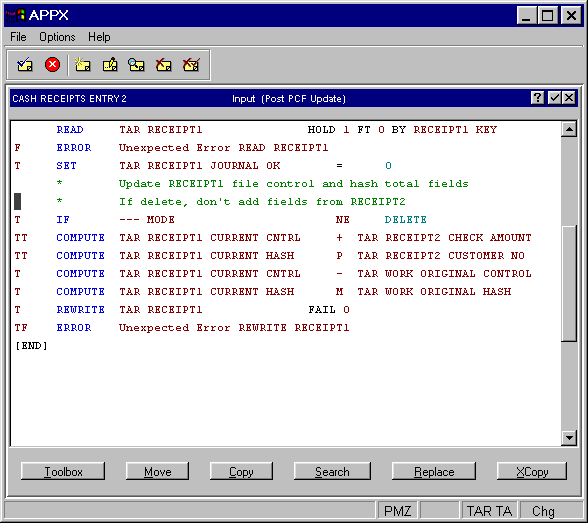
There are a number of APPX event points, each of which provides access to a process at a specific point in its execution sequence. They exist at four levels: process, frame, image, and child invocation. In addition, each type of process has a slight variation in the specific event points it includes at each level. Table 3-1-3 summarizes the event points that execute for each process type.
Refer to Chapter 3-16: Using Event Points for general information about each event point, including a definition and the chronology according to which it executes.
| Event Point | Menu | Job | Input | Output | Update | Query | Inquiry | Status | Subr |
|---|---|---|---|---|---|---|---|---|---|
| Process-Level | |||||||||
| Start of Process | Yes | Yes | Yes | Yes | Yes | Yes | Yes | Yes | Yes |
| Set Run-Time Defaults | Yes | ||||||||
| Post PCF Read | Yes | Yes | Yes | ||||||
| Pre-PCF Update | Yes | ||||||||
| Post PCF Update | Yes | ||||||||
| Pre-User Selection | Yes | ||||||||
| Post User Selection | Yes | ||||||||
| Start of Query Execution | Yes | ||||||||
| End of Query Execution | Yes | ||||||||
| End of Process | Yes | Yes | Yes | Yes | Yes | Yes | Yes | ||
| Frame-Level | |||||||||
| Start of Frame | Yes | Yes | Yes | Yes | |||||
| Select Image | Yes | Yes | Yes | ||||||
| Global Pre-Display | Yes | Yes | Yes | ||||||
| Global Option Intercept | Yes | Yes | |||||||
| End of Frame | Yes | Yes | Yes | ||||||
| Image-Level | |||||||||
| Pre-Display | Yes | Yes | Yes | Yes | |||||
| Pre-Display Verify | Yes | Yes | |||||||
| Option Intercept | Yes | Yes | Yes | ||||||
| Verify | Yes | Yes | |||||||
| Child-Level | |||||||||
| Pre-Invocation | Yes | Yes | Yes | Yes | Yes | Yes | |||
| Post Invocation | Yes | Yes | Yes | Yes | Yes | Yes |